What is VeriFactu and how do I get my business's POS ready for 2027?
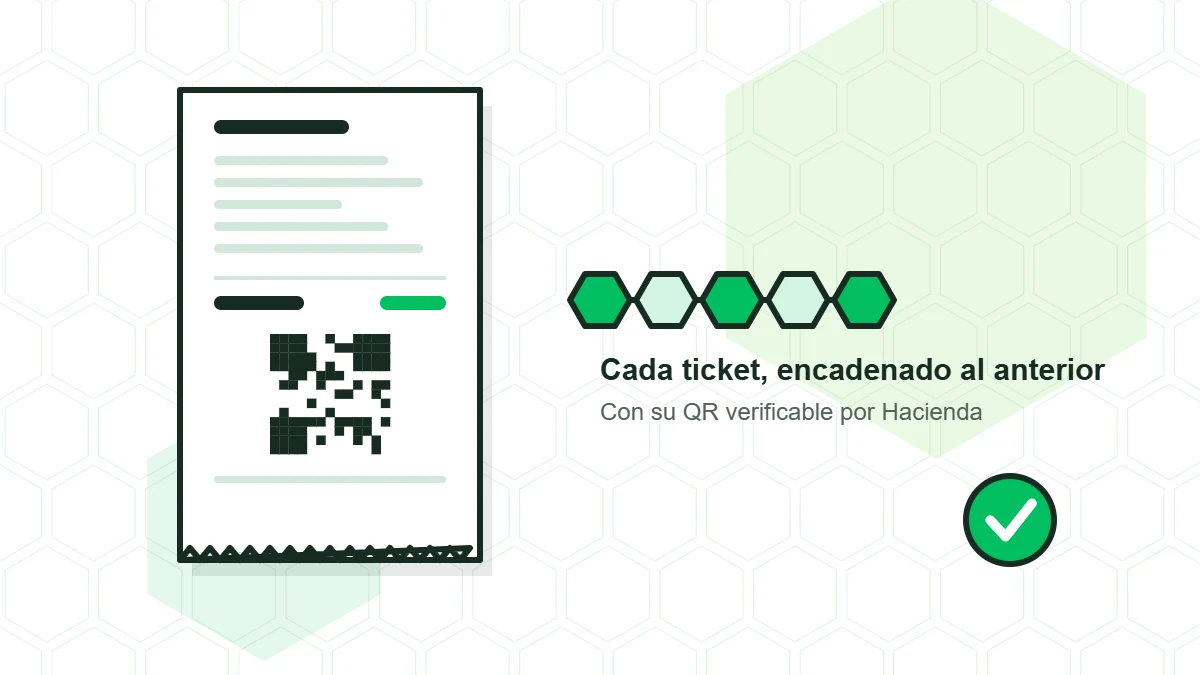
VeriFactu is the verifiable invoicing system regulated by Royal Decree 1007/2023 and Order HAC/1177/2024. It requires your till software to store every receipt and invoice in a record linked to the previous one by a fingerprint (hash), and the printed receipt to carry a QR code that the Agencia Tributaria can check.
Who does VeriFactu apply to?
It applies to every self-employed person or company that invoices using software, so the till of a café, a shop or a hair salon is covered. It does not affect those who already send their books through the Immediate Supply of Information system (SII), mainly large companies, nor anyone who still writes invoices by hand, with no software at all.
What changes when you take payment with VeriFactu?
- The receipt prints with a QR code and, if you work in the VeriFactu mode, with the text «Factura verificable en la sede electrónica de la AEAT» or «VERI*FACTU».
- A receipt that has been issued can no longer be deleted or edited: it is cancelled or corrected with a corrective invoice, and everything is recorded.
- Each record stores the fingerprint of the previous one. If someone tampers with a piece of data, the link breaks and the manipulation is detected.
- There are two ways to comply: send each record to Hacienda straight away (VeriFactu mode) or keep them in the software and hand them over if requested.
What do I need to check on my POS?
- That your software already has the VeriFactu-ready version and the manufacturer's declaration of compliance (declaración responsable). Sysme and Glop, for example, already have it.
- That this version is the one running on your venue's till and not an old one.
- That your NIF, company name, address and IGIC rates are entered correctly: with VeriFactu any mistake is recorded in the register.
- That the QR code prints legibly on paper. Some old 58 mm printers print it so small that it can't be read.
When does VeriFactu become compulsory?
After the postponement approved in 2025, companies that pay Corporate Income Tax must comply from 1 January 2027, and the self-employed and other obliged parties from 1 July 2027. Getting up to date usually fits into a single visit, but if everyone leaves it until the end there won't be enough technicians for so many tills at once, so it pays to do it in good time.